
Privacy Xray
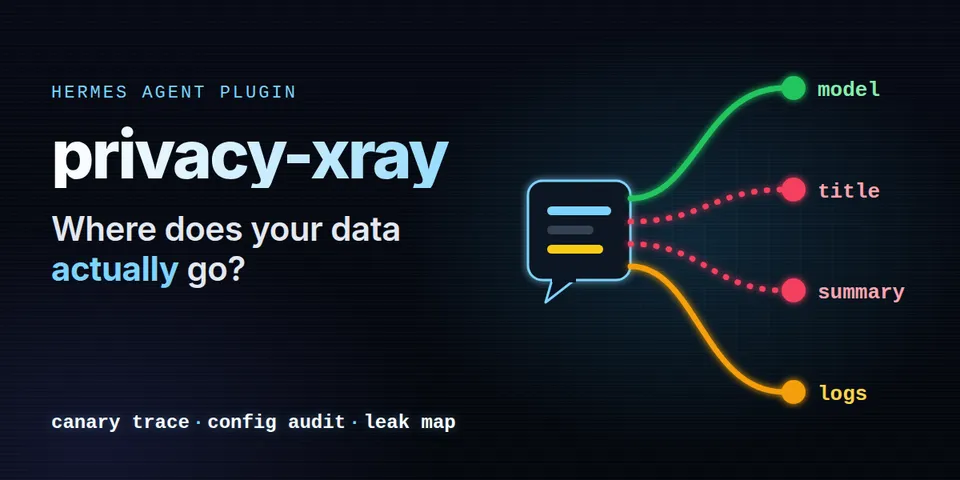
From its catalog listing
Where does your data actually go? Records every outgoing model request, the main loop and side tasks such as title generation, compression and vision, as metadata only: destination host, vendor, vendor HQ country, the model vendor behind aggregators such as OpenRouter (read from the model id; the final processing vendor behind an aggregator is not visible), size and counts of detected personal data types (e-mail, IBAN, payment card, phone, IPv4, German Steuer-ID and USt-IdNr, own watch terms). /xray canary invents a fictitious person and /xray trace shows every request and local store that carried it. /xray check audits the config with a severity and the exact hermes config set fix per path; /xray fix <id> --yes applies one; a session retention hint is advice only and is never applied. /xray fix --yes and /xray find run only on local surfaces (CLI, TUI, desktop, dashboard) unless allow_sensitive_on_gateways is turned on. /xray find searches the local stores for a person, /xray report writes a self-contained HTML leak map (no scripts, no external assets) with a before and after view of two canaries; a dashboard tab shows the same page in a sandboxed frame. Not legal advice and not a compliance certificate.
Good to know before installing
no network calls, no model calls, standard library only. pre_api_request and pre_auxiliary_call are observers; they write one metadata line per request (time, session and turn id, task, provider, model, host, vendor, counts, canary id and message fields; never message text or matched values) to HERMES_HOME/plugin-data/privacy-xray/ledger.jsonl (rotated once at ledger_max_mb, default 5 MB). The llm_request middleware is off by default (guard: false); when turned on it masks canary values and watch terms in main model requests before they are sent. Reads the merged Hermes config through load_config_readonly. /xray trace, /xray find and /xray check read outside the plugin's own data, read-only and under a time budget (scan_seconds, default 30): state.db (messages, session titles, stored system prompts, delivery queue), session files including request dumps, memories, logs, cron output, other plugins' plugin-data, paste and pending folders; output shows counts and masked snippets only. Writes config only on /xray fix <id> --yes, through hermes_cli.config.set_config_value (same code as hermes config set); never deletes files. Stores fake canary persons, last check and trace results and requested HTML or Markdown/JSON reports under its plugin-data folder. Registers the tool privacy_xray (map, check, trace, find; read-only, never changes settings), the slash command /xray and a skill that adds one line to the skills index of every session while the plugin is enabled. No credentials, no shell commands, no cron jobs, no background processes, no telemetry.
From its catalog listing.
How to install
- Install it. Hermes asks for any API keys it needs, then asks whether to turn it on.
hermes plugins install privacy-xray - Said no? Turn it on later:
hermes plugins enable privacy-xray - Restart Hermes so it loads the plugin.
Some plugins also need a sign-in or settings: see Full setup & settings. Memory plugins ask whether to become your memory provider instead. Steps follow the official plugins guide (opens in a new tab).
- Category
- Cost, speed & monitoring
- Maintained by
- MadeByBrain (Community)
- Needs
- No API keys declared
- Adds tools
privacy_xray- Adds hooks
pre_api_requestpre_auxiliary_call- Needs Hermes
- 0.22.7 or newer
- Version
- 1.0.0
- In the catalog
- 2026-11-07
Using the Hermes desktop app? See where plugins live

Full setup & settings ↗Source code ↗
More in cost, speed & monitoring
All cost, speed & monitoring plugins
New Hermes Agent updates every day on X. Follow @HermesWatcher