
NEURAL_MESH
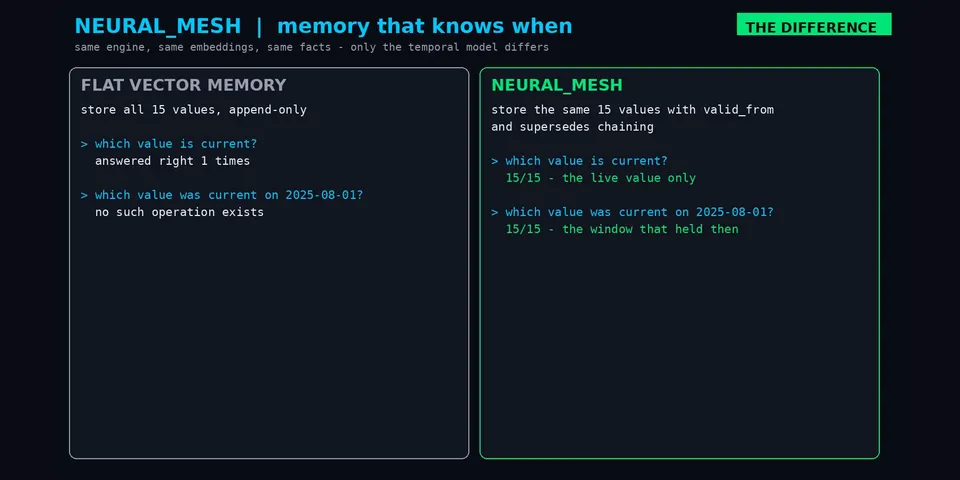
From its catalog listing
Bi-temporal long-term memory for Hermes: point-in-time recall (mesh_asof answers what was true on a date, not only what is true now), supersession instead of overwrite so a corrected fact keeps its history, hybrid dense + lexical retrieval, a poisoning quarantine, and an injection floor measured on a 15-family ablation.
Good to know before installing
this is a Hermes MemoryProvider (`memory.provider: neural-mesh`). It stores user turns, pre-compression and session-end message extracts, and mirrored MEMORY.md/USER.md writes in an unencrypted local SQLite file at `<profile>/neural-mesh/mesh.db`, so credentials do not belong in it. The provider makes no network calls and needs no API key. The repo also vendors unused upstream modules with LLM/chain HTTP clients that the provider never calls. It ships no compiled binary (the Rust extension is not vendored, so retrieval runs the pure-Python path).
From its catalog listing.
How to install
- Install it. Hermes asks for any API keys it needs, then asks whether to turn it on.
hermes plugins install neural-mesh - Said no? Turn it on later:
hermes plugins enable neural-mesh - Restart Hermes so it loads the plugin.
Some plugins also need a sign-in or settings: see Full setup & settings. Memory plugins ask whether to become your memory provider instead. Steps follow the official plugins guide (opens in a new tab).
- Category
- Memory & notes
- Maintained by
- D0xedDevi0 (Community)
- Needs
- No API keys declared
- Adds tools
mesh_remembermesh_recallmesh_asofmesh_stats- Adds hooks
on_session_endon_pre_compresson_memory_write- Needs Hermes
- 0.22.0 or newer
- Version
- 0.39.0
- In the catalog
- 2026-11-10
Known issues (from its catalog listing)
- The memory store is plain, unencrypted SQLite inside the Hermes profile — anything it remembers is readable by anyone with filesystem access to that profile, so credentials do not belong in it.
- The upstream Rust resonance extension is not shipped (catalog rule 17), so retrieval uses the pure-Python path; mesh_stats reports resonance_backend: python rather than rust.
- Automatic context injection is held to a measured 0.25 score floor, so a weakly-matching memory is deliberately not injected. Use mesh_recall (0.05 floor) when you want a wider net.
- Superseding a memory that does not exist is reported in the tool reply rather than failing the write, so a correction naming a bad id is stored as a new fact — and the reply says so instead of silently leaving two contradictory values current.
Using the Hermes desktop app? See where plugins live

Full setup & settings ↗Source code ↗
More in memory & notes
New Hermes Agent updates every day on X. Follow @HermesWatcher