
Manyhands
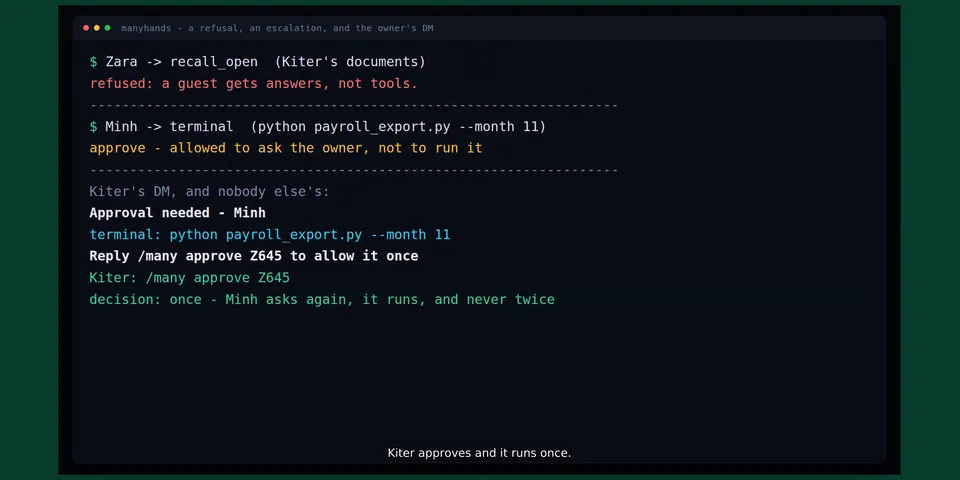
From its catalog listing
Identity, memory and permissions for every person who talks to one Hermes bot. A gateway is a single-operator agent: the platform already carries sender_id and platform into every turn and nothing acts on it, so everybody in a group or a household shares the same memory, the same tools and the same approval authority. manyhands acts on it. Roles (owner, member, guest, blocked) are resolved from the platform event, never from message text, and applied as three states per tool: allow runs, ask parks the call under a four-character code and sends it to the owner's own DM, and everything else is refused with a message that names only the asker's own role. `/many approve CODE` opens a one-shot grant bound to that person and that tool, spent by the next call and expired on silence — only a human typing the slash command can approve, and nobody can approve their own ask. The operator's own MEMORY.md and USER.md blocks are withheld from everybody else's system prompt and replaced with a card about that person, because "everyone gets their own Hermes" has to include not handing a stranger your notes; each person also gets their own facts, their own token budget, and `/many pause`. Six tools (whoami, people, remember, recall, share, audit — `people` is read-only: a roster change is a human-typed verb, never a tool call) and `/many` (roster, invite, claim, add, role, tools, budget, audit, approve, deny, pause) whose owner-only verbs stay owner-only because a command's identity comes from the platform event too, so a stranger typing in the owner's own chat session is still a stranger. Identity fails closed: a session with no human turn on it — a restart, a subagent, a tool driven from the gateway socket — gets the guest allowlist, not the owner's, and a tool call in a session more than one person has spoken in is attributed by the task id the host dispatches with (or refused, never guessed from the last speaker). Every turn, tool decision, refusal, escalation, approval, spent grant and token count is an audit row you can read back.
Good to know before installing
hooks, one middleware, six tools, the `/many` command and the `manyhands` approval transport, no other capability. pre_llm_call resolves the sender from the platform event, records the session and turn to person map, redeems `join CODE` invites and appends that person's facts to their turn; pre_tool_call applies the role to the tool allowlist, parks asks, spends grants and fails closed; post_api_request records token usage per person; an llm_request middleware rewrites the outgoing provider request for non-owners, removing the operator's memory blocks and injecting the person card. One SQLite file under plugin-data/manyhands (people, facts, shared facts, invites, approvals, sessions, settings, audit) holding sender ids as platform:sender_id, roster names you set, the facts people store and the audit trail; `/many remove` deletes a person and their facts. Reads no other file on disk, runs no command, makes no network call, imports nothing outside the Python standard library and calls no model. Approval prompts are delivered through the host's own gateway injection into the owner's DM, which the host records as a turn in that chat.
From its catalog listing.
How to install
- Install it. Hermes asks for any API keys it needs, then asks whether to turn it on.
hermes plugins install manyhands - Said no? Turn it on later:
hermes plugins enable manyhands - Restart Hermes so it loads the plugin.
Some plugins also need a sign-in or settings: see Full setup & settings. Memory plugins ask whether to become your memory provider instead. Steps follow the official plugins guide (opens in a new tab).
- Category
- Memory & notes
- Maintained by
- PhiBao (Community)
- Needs
- No API keys declared
- Adds tools
manyhands_whoamimanyhands_peoplemanyhands_remembermanyhands_recallmanyhands_sharemanyhands_audit- Adds hooks
pre_llm_callpre_tool_callpost_api_request- Needs Hermes
- 0.23.0 or newer
- Version
- 0.6.0
- In the catalog
- 2026-11-11
Known issues (from its catalog listing)
- Identity is only as good as the platform event, and a call that carries none fails closed: a session that never had a human turn on it, a subagent, and a tool called from inside `execute_code` (the host passes an empty session id there) all get the guest allowlist rather than the owner's. Set `unknown_session_policy: operator` if every caller on your machine is trusted. Machine-generated turns are recognised by a marker AND the absence of a sender, so a cron prompt is the operator's while a guest who types `[cron]` stays a guest.
- DM routing is Telegram-shaped: a private chat id is the user id, so the approval prompt reaches that chat. Other platforms need their own DM resolution; the prompt fails closed there rather than guessing, which means asks are denied until a code is minted another way.
- The operator's own memory is withheld by removing the two built-in block titles (MEMORY, USER PROFILE). A block rendered by a third-party memory provider is not removed, so run manyhands without one if that matters to you.
- A plugin escalation cannot use Hermes's approval-transport seam: request_tool_approval routes it through _ACTION_GATE, which is built with transport=False. manyhands parks and DMs the ask itself and leaves the registered transport to the dangerous-command prompts that do consult it.
- The approval prompt arrives as a plugin-triggered turn in the owner's chat (inject_gateway_message), so each prompt costs one turn in that conversation; keep approval_timeout_s honest so a stale code cannot sit there long.
Using the Hermes desktop app? See where plugins live

Full setup & settings ↗Source code ↗
More in memory & notes
New Hermes Agent updates every day on X. Follow @HermesWatcher