
Elcaro
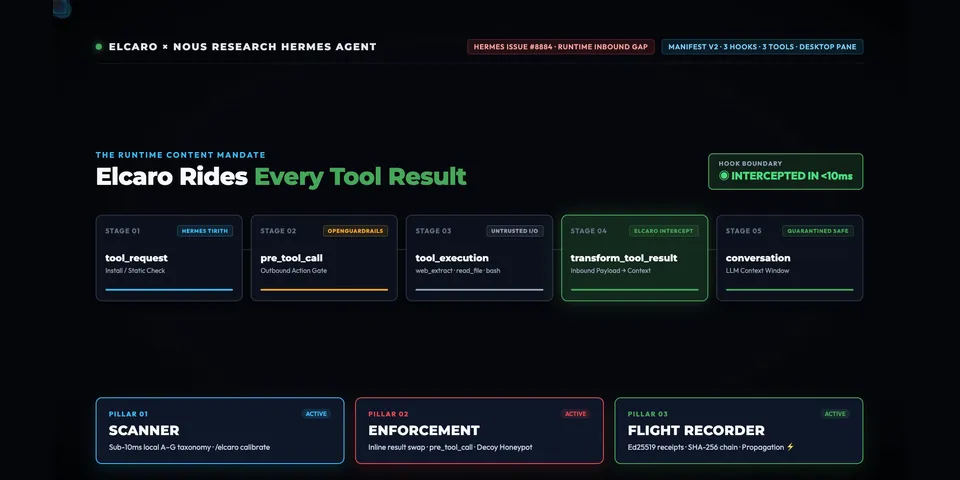
From its catalog listing
Runtime prompt-injection defense and tamper-evident flight recorder. Every tool result is scanned before it reaches the model by a deterministic detector taxonomy (sub-10 ms, fully local, vendored — no network by default); quarantined content is replaced in place with a signed [CONTENT QUARANTINED] notice via transform_tool_result, and tool-call arguments (write_file, terminal, memory) are scanned for smuggled payloads via pre_tool_call. Beyond content, a kernel gate: a quarantine taints the session, and while tainted credential-path reads/writes and instruction-file writes are refused, network egress and outside-workspace writes escalate to the approval gate — tool_call, execute_code and process_manage are evaluated as the action they really make, and taint propagates into subagents via subagent_start. A canary-baited decoy credentials file (ELCARO-DECOY-* marker) forces a deterministic 1.0 quarantine on exfiltration; canary provenance edges record an injection propagating between scans; every verdict lands in a hash-chained, Ed25519-signed threat log with a Desktop pane (chain-verified badge, honeypot status, propagation rows, signed-receipts drawer), a /elcaro slash command (status / calibrate / verify / explain), and a `hermes elcaro` CLI. Two on-demand tools close the loop input scanning can't: elcaro_lint_response flags concealed-compromise artifacts in agent output (canary echoes, text-channel tool calls, tracking pixels, secrets — caught 148/152 compromised transcripts in the public 24-task IPI benchmark), and elcaro_harden_prompt returns a hardened system prompt plus a gullibility score. Engine validated on that benchmark: 22/22 attack tasks flagged (regression coverage, not held-out proof).
Good to know before installing
scanning is fully local by default: the vendored engine's env-driven LLM second passes (api.openai.com, inference-api.openserv.ai and others) and its Postgres canary registry are built disabled; scanned tool-result text leaves the machine only when the user sets the optional `api_url` hosted lane, which POSTs it there with the optional `ELCARO_API_KEY`; the optional `ELCARO_SIGNING_KEY` is read from the profile secret store; it writes only to its plugin data dir (threat-log.jsonl, decoy-marker.txt, and a bait service-credentials.env decoy it never reads); a quarantine taints the session so credential-path and instruction-file writes are refused and network/outside-workspace actions escalate to Hermes approval (nothing auto-approves); Python deps pydantic, cryptography, httpx; no core overrides.
From its catalog listing.
How to install
- Install it. Hermes asks for any API keys it needs, then asks whether to turn it on.
hermes plugins install elcaro - Said no? Turn it on later:
hermes plugins enable elcaro - Restart Hermes so it loads the plugin.
Some plugins also need a sign-in or settings: see Full setup & settings. Memory plugins ask whether to become your memory provider instead. Steps follow the official plugins guide (opens in a new tab).
- Category
- Memory & notes
- Maintained by
- udirobert (Community)
- Needs
- No API keys declared
- Adds tools
elcaro_scanelcaro_quick_scanelcaro_explainelcaro_lint_responseelcaro_harden_prompt- Adds hooks
transform_tool_resultpre_tool_callpre_llm_callsubagent_start- Works on
- windows, macos, linux
- Needs Hermes
- 0.22 or newer
- Version
- 1.1.0
- In the catalog
- 2026-11-11
Using the Hermes desktop app? See where plugins live

Full setup & settings ↗Source code ↗
More in memory & notes
New Hermes Agent updates every day on X. Follow @HermesWatcher